
The Malignant Mind
The Psychiatric Patterns of the Global Strongman

Trump revives an old vision of American power, with global implications
Trump and his top allies suggested that the Venezuelan operation could be the start of efforts to remake the region, warning the governments of Cuba and Colombia that they might be next. Trump and some backers have also brought up Mexico as a potential target, and they are reviving talk of attempting to acquire Greenland, a Danish territory.
Washington Post January 5, 2026
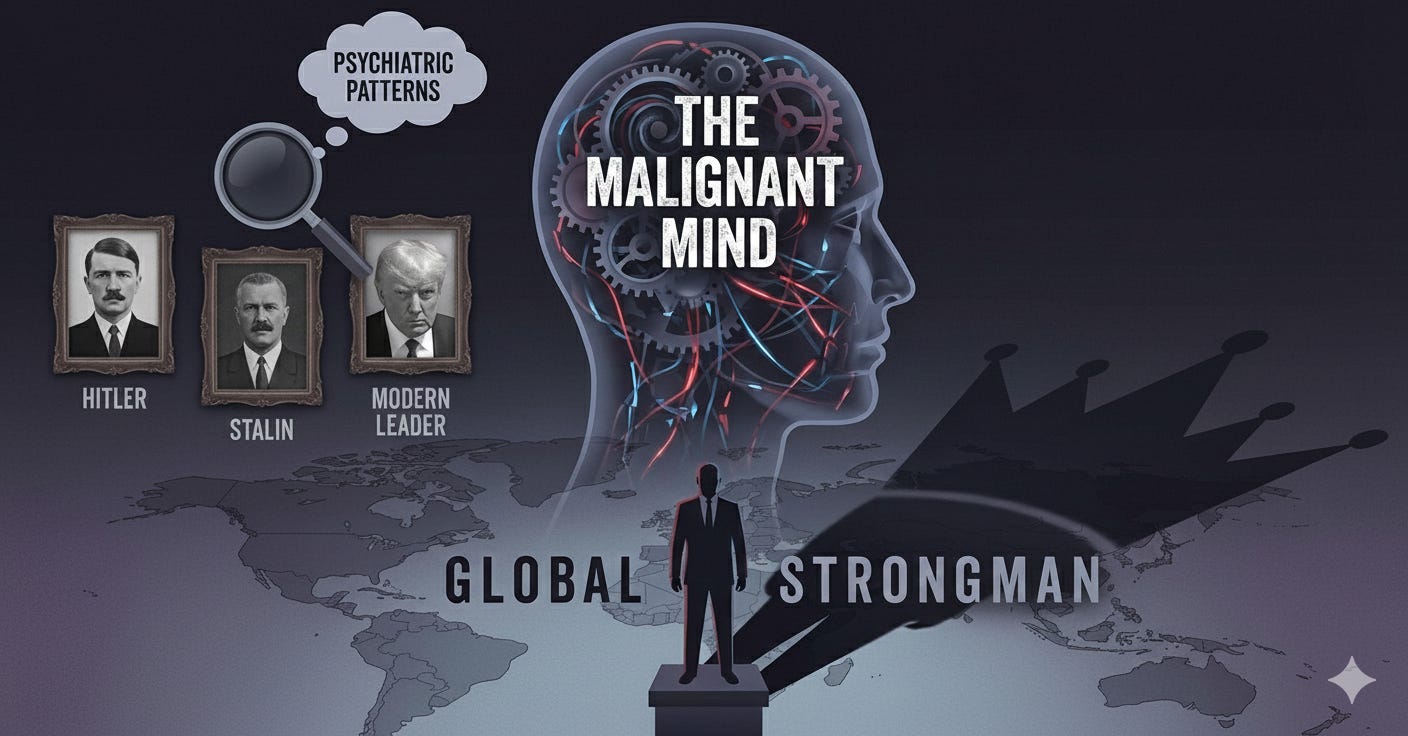
We’ve explored psychiatric themes recently over at the Specifically for Seniors podcast in our episode on Narcissism and National Harm with Dr. Jocelyn Sze. The conversation highlighted a chilling reality: when leaders believe they can take whatever they want, it isn’t just a political strategy—it’s a psychiatric pathology. From Adolf Hitler’s systematic quest for Lebensraum to modern declarations of territorial control by Donald Trump, the underlying mental processes remain strikingly consistent. This isn’t about comparing the scale of their regimes, but about understanding the psychological patterns—including malignant narcissism, grandiose delusions, and the “Dark Triad”—that allow certain leaders to genuinely believe they are entitled to seize territory, override sovereignty, and dominate weaker nations.
The core of this psychiatric pattern is malignant narcissism, a term coined by Erich Fromm and expanded by Otto Kernberg to describe the “quintessence of evil” found in dictatorial tyrants like Hitler and Stalin. This pathology is a toxic brew of four traits: narcissism (grandiosity), antisocial behavior (lack of remorse), paranoia, and sadism. While researchers have long recognized this in Mao Zedong and Stalin, over 200 psychologists have recently applied these behavioral criteria to Donald Trump. As noted in the open letter from mental health professionals, ”his behavior is consistent with narcissistic, antisocial, and paranoid personality disorders, made worse by sadistic tendencies.” Experts point to his requirement for absolute loyalty and his “pathological detachment from reality” as indicators of a mind that functions outside the bounds of traditional political leadership, mirroring the psychological structures of historical dictators who view themselves as above the law and the truth.
At the heart of this behavior lies grandiose delusions—beliefs in one’s exceptional power that persist despite overwhelming evidence to the contrary. Hitler believed the Aryan race was destined to rule the world; Japan’s militarists believed in a divine mission to reorganize Asia. Trump’s behavior fits this remarkably well, manifesting in a conviction that he has the unilateral right to “run” or acquire other nations. His recent assertions regarding the Western Hemisphere have crossed unprecedented lines, including his stated desire to annex Greenland and his declaration that the United States will “run” Venezuela following the military operation in Caracas. His rhetoric has expanded to include claims that Canada should become the 51st state, threats of military action against Colombia over drug enforcement, the suggestion that Mexico should be “subsidized” into statehood, and the declaration that the government in Cuba is “in a lot of trouble,” signaling a renewed campaign for regime change. As psychologist John Gartner observed, ”Narcissism impairs his ability to see reality. Three million women marching? Doesn’t move him. Advisers point out that a policy choice didn’t work? He won’t care.” Like the leaders of the past, this isn’t a strategic calculation but a grandiose delusion where the leader believes their “specialness” entitles them to take whatever they want.
The conviction that one has the right to dominate stems from a fragile, inferior core masked by extreme grandiosity. To protect this “grandiose self,” the leader organizes the world into a paranoid binary: the superior “us” versus the threatening “them.” Hitler projected negativity onto Jews and Slavs, while Trump’s rhetoric identifies “enemies within”—migrants, journalists, or “liberal elites”—as existential threats. This lack of empathy is a cognitive deficit; others are not seen as human beings with rights, but as objects to be used. When world leaders discusses “taking” a neighboring country’s resources or controlling their trade, they are demonstrating the malignant narcissist’s worldview where others’ desires are irrelevant obstacles to their own self-interest.
Perhaps the most disturbing element is the sadistic component—taking pleasure in inflicting pain and humiliation on others. Mental health professionals note that this is an integral part of how these individuals maintain their sense of superiority. Whether it was Hitler’s dehumanization of entire races or reports of Trump watching the violence of January 6 with “glee,” the sadistic enjoyment of power provides the leader with “narcissistic supply.” As one report on the insurrection noted, ”Trump watched the violence... with glee, watching his favorite parts over and over on rewind.” This is further enabled by the Dark Triad (narcissism, psychopathy, and Machiavellianism), which allows a leader to be charismatic and persuasive on the surface while remaining strategically manipulative and free from normal emotional constraints or guilt.
Psychiatrist Robert Jay Lifton’s concept of “malignant normality” explains how a society can eventually normalize these pathologies. When a malignant narcissist gains power, they reshape institutional reality to make their delusions appear normal. Through a personality cult, followers enter a “group narcissism” loop, elevating the leader to compensate for their own feelings of inadequacy. As Dr. Robert Jay Lifton explained: “Malignant normality occurs when a society’s institutions and people begin to normalize what would otherwise be seen as pathological.” This creates a dangerous symbiosis: the leader needs validation for their grandiose self, while the followers seek a “strongman” to make things simple again. This trajectory is predictable and dangerous; malignant narcissism does not improve with power—it escalates. History teaches us that such minds, unchecked by empathy or reality, represent one of the most dangerous forces in human history.
The solution to the rise of the malignant mind is rarely found in reasoning or compromise, as the psychological profile of these leaders lacks the empathy and self-reflection necessary for fair evaluation. Instead, the path forward requires a multi-pronged strategy of containment and resilience. First, we must establish clear, unwavering boundaries—both individually and institutionally—to limit destructive behaviors before they escalate into "malignant normality." This involves strengthening democratic guardrails and maintaining what psychologists call a "healthy suspicion" of the mesmerizing charisma often used by these figures to infantilize their followers. Second, we must address the "group narcissism" that feeds these leaders by promoting media literacy and critical thinking, ensuring citizens do not surrender their agency to a "strongman" who promises simple fixes for complex anxieties.
Ultimately, the most powerful defense against a leader who believes they are entitled to everything is a society that recognizes its own collective value and refuses to validate a reality built on delusions of dominance.
FTS
This space isn’t meant to be a monologue. It’s a dialogue — sharp, satirical, and sometimes uncomfortable. Do you agree with the stance? Disagree with the framing? See illusions I’ve missed? Add your voice. Comment, challenge, expand, dismantle. The sharper the exchange, the clearer the vision. Disillusionment isn’t passive; it’s participatory.
Join us on our podcast Specifically for Seniors, where satire meets substance and storytelling sparks civic engagement. Each episode dives into topics like authoritarianism, political spectacle, environmental justice, humor, history and even fly fishing and more—layered with metaphor, wit, and historical insight. We feature compelling guest interviews that challenge, inspire, and empower, especially for senior audiences and civic storytellers. Listen to the audio on all major podcast platforms, watch full video episodes on YouTube, or explore more at our website.
Let’s keep the conversation sharp, smart, and unapologetically bold.
The shoe appears to fit perfectly.